Pages

Subscribe:

Ads 468x60px

Showing posts with label Audi. Show all posts

Thursday, October 27, 2011

Audi RS5 2011 I Audi RS5 I Audi RS5 Interior

Audi RS5 Interior

Audi RS5 Colour

Audi RS5 Stream

Audi RS5 Top Speed

The Audi RS5 Coupé is the star athlete of the A5 family. It offers the power and handling of a powerful sports car packaged in the body of an alluringly elegant coupe. The design has now gained several new, sharp accents, with numerous features that characterize the other A5 models also making their way to the RS5.

The Audi RS5 Coupé uses a high-revving, normally aspirated V8 displacing 4,163 cc. This engine is closely related to the V10 that powers the R8 high-performance sports car. The 4.2 FSI delivers 331 kW (450 hp) at 8,250 rpm, with the peak torque of 430 Nm (317.15 lb-ft) available between 4,000 and 6,000 rpm. The engine has a specific output of 108.1 hp per liter of displacement. The potent response, the eager revving and the rich, melodious sound mark the V8 as a thoroughbred racing engine.

Hand-built at the plant in Györ, Hungary, the 4.2 FSI launches the Coupé from zero to 100 km/h (62.14 mph) in 4.6 seconds. Audi will increase the electronically governed top speed from 250 to 280 km/h (155.34 to 173.98 mph) upon request. Thanks to the combination of technologies from the Audi modular efficiency platform, which also includes a recuperation system, the high-tech V8 consumes significantly less fuel on average than its direct competitors

High end: quattro with crown-gear differential

Like all RS models, the Audi RS5 Coupé also applies its power to the road with quattro permanent all-wheel drive. The crown-gear center differential at its heart is compact and lightweight. It can vary the distribution of torque between the front and rear axles lightning-fast and over a wide range, with up to 70 percent flowing to the front or as much as 85 percent to the rear, as necessary. The default 40:60 ratio of the rear-biased configuration ensures sporty handling.

Precise and stable: the chassis
The taut setup lowers the body by 20 millimeters (0.79 in) compared with the Audi A5. Newly designed, 19-inch forged aluminum wheels with 265/35-series tires are standard; 20-inch wheels with 275/30-series tires are available as an option for the high-performance coupe.

The brake system of the RS Coupé features large, internally ventilated wave brake discs, with the front discs measuring 365 millimeters (14.37 in) in diameter. The steel friction rings with their wave-like outer contour are perforated and connected to the aluminum brake caps via pins. This direct structure reduces tensions, quickly dissipates the heat and prevents the transmission of temperature peaks. Moreover, the redesigned shape of the friction rings results in three kilograms (6.61 lb) of weight being saved in total, thus improving the balance of unsprung masses.

Unmistakable: The design

The Audi RS5 Coupé has an athletic road stance, and its classically elegant two-door lines dazzle with clear-cut accents. The new single-frame grille with beveled upper corners features a high-gloss, anthracite gray honeycomb structure and a matt aluminum-look frame. The standard xenon plus headlights are framed by narrow strips of LED daytime running lights. The air flows through large openings embedded in a distinctive bumper featuring a splitter edge like on a racing car. Sharper edges make the engine hood appear more three-dimensional so that the RS5 looks even lower and wider when viewed from the front.

Dynamic elegance: The interior

The vehicle's dynamically elegant styling also extends to the interior. The standard sport seats with integrated headrests are power adjustable and covered in a combination of black leather and Alcantara. Audi also offers seat upholstery in Fine Nappa leather in a choice of black or lunar silver, both subtly accented with rock gray piping. Other options include bucket seats with folding backrests or comfortable, climate-controlled comfort seats with a ventilation function. The interior is bathed in black, with narrow chrome clasps at the switches and control elements providing delicate accents. Inlays are available in a choice of carbon, brushed or etched aluminum, a high-gloss piano finish or a light-colored stainless steel mesh.

Audi RS3 Sportback I Audi RS3 Sportback Image I Audi RS3 Sportback Review

Audi RS3 Sportback Review

Audi RS3 Sportback Image

Audi RS3 Sportback Relly

Audi RS3 Sportback The Board

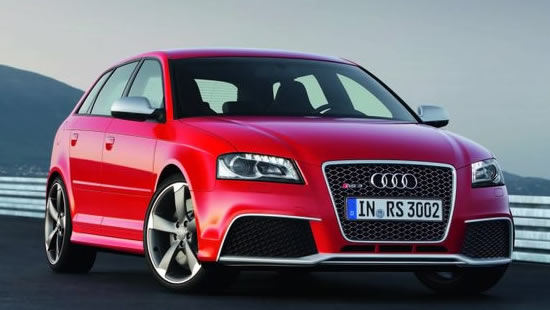
Big performance in a small package - the Audi RS3 Sportback is the newest member of the dynamic Audi RS family. Its turbocharged 2.5-liter five-cylinder engine pumps out 250 kW (340 hp) and delivers 450 Nm (331.90 lb-ft) of torque. The unit accelerates the Audi RS3 Sportback into the league of powerful sports cars while consuming just 9.1 liters of fuel per 100 km on average (25.85 US mpg).

Power from the 2.5 TFSI is transmitted to the road via a seven-speed S tronic and quattro permanent all-wheel drive. 19-inch wheels and fenders made of carbon-fiber-reinforced plastic (CFRP) underscore the Audi RS3 Sportback's position of distinction.

Dynamic par excellence: the drivetrain and suspension

A seven-speed S tronic comes standard in the Audi RS3 Sportback. The compact dual-clutch transmission shifts gears almost imperceptibly, with extreme speed and comfort. Seventh gear is very tall - a measure that reduces fuel consumption. In addition to two automatic programs, a manual mode is available, which can be controlled with optional paddles on the steering wheel. The launch control system manages maximum acceleration from a standing start.
The Audi RS3 Sportback has 19-inch wheels. The front tires are size 235/35, whereas the tires at the rear are 10 millimeters (0.39 in) narrower to further enhance handling. The internally ventilated brake disks measure 370 millimeters (14.57 in) in diameter at the front and 310 millimeters (12.20 in) at the rear. The front friction rings are perforated.

Design and body

The new, dynamic top-of-the-line model in the A3 series reveals its potential from the very first glimpse. The single-frame grille, the defining element at the front of the car, features a high-gloss anthracite-colored insert with diamond-patterned styling. A frame in matt aluminum look encircles the grille, and an RS3 badge adorns it. Xenon plus lights are standard on the Audi RS3 Sportback, with integrated LED daytime running lights that form a striking contour
The Audi RS3 Sportback is 4.30 meters (14.11 ft) long, 1.79 meters (5.87 ft) wide, and 1.40 (4.59) meters high. It achieves a drag coefficient of cd 0.36 and has a frontal area of 2.16 sq m (23.25 sq ft). Its curb weight is 1,575 kilograms (3,472.28 lb). In its normal configuration, the luggage compartment has a capacity of 302 liters (10.67 cubic ft), but with the rear seatbacks folded down, it holds an impressive 1,032 liters (36.44 cubic ft). As options Audi also offers practical components, including a luggage compartment package and a load-through hatch with or without a ski bag

nterior

A distinctive interior design with sporty circular air nozzles, perfect ergonomics and a no-holds-barred approach to quality in the selection and use of materials - these are all typical traits of the Audi A3 model line. In addition to these, the Audi RS3 Sportback comes with a host of special features.

Engine

For decades, gasoline engines with turbocharging technology have been the domain of Audi - the five-cylinder TFSI in the Audi RS3 Sportback carries on the tradition of high-performance engines. From 2,480 cc of displacement, it draws 250 kW (340 hp) of power, which is available between 5,400 rpm and 6,500 rpm. Its specific output is 100.8 kW (137.1 hp) per liter of displacement. The maximum torque is 450 Nm (331.90 lb-ft) - it is readily available at the low end of the rev range, around 1,600 rpm, and remains constant up to 5,300 revolutions.

Blazing acceleration: 0 - 100 km/h (62.14 mph) in 4.6 seconds

The Audi RS3 Sportback accelerates from a standing stop to 100 km/h (62.14 mph) in 4.6 seconds - faster than any competitor in the compact category. Its superb pulling power allows it to pass other cars without the slightest effort. Top speed electronically is limited to 250 km/h (155.34 mph). Underneath the hood lies the engine with its red cylinder-head cover exposed - a fascinating piece of technology and a treat for the eyes.

In terms of fuel consumption, the powerful five-cylinder engine is frugal, using on average just 9.1 liters of fuel per 100 km (25.85 US mpg) and emitting 212 g CO2 per km (341.18 g/mile). This efficiency, which puts the Audi RS3 Sportback clearly ahead of its main competitors, can be attributed to the combination of FSI direct injection and turbocharging, two core competencies of the brand with the four rings. In motorsport, the toughest test laboratory in the world, TFSI technology has powered the Audi R8 to five final wins in the 24 Hours of Le Mans.

Turbo throughput: 335 liters (11.83 cubic ft) of air per second

The large turbocharger is generously sized, with a compressor wheel that measures 64 millimeters (2.52 in) in diameter at the outlet. At full load, the charger is able to compress up to 335 liters (11.83 cubic ft) of air and generates boost pressures of up to 1.2 bar. Its housing has a separate oil supply, and a dedicated water pump provides cooling. The intercooler lowers the temperature of the compressed air at full load, thereby achieving an efficiency of over 80 percent. Much effort has gone into optimizing the entire intake path to minimize pressure loss.

Drivetrain

Audi delivers the Audi RS3 Sportback with the seven-speed S tronic as standard. The high-tech gearbox transmits power via three shafts: one drive shaft and two output shafts. This layout results in a short construction - a prerequisite for interaction with the transversely mounted engine.
The S tronic operates with two multi-plate clutches. The large K1 clutch located on the outside conducts the torque from the engine via a solid shaft to the gear wheels for the odd gears 1, 3, 5 and 7. A hollow shaft rotates around the solid shaft. It is connected to the second, smaller K2 clutch, which is located inside its larger sibling, and which controls the gear wheels for the gears 2, 4 and 6, as well as reverse gear.The seven-speed S tronic in the Audi RS3 Sportback has an oil volume that lubricates and cools - as well as drives - the wheel sets, clutches and components of the mechatronic system. A positioning valve regulates the oil flow to the clutches as needed, keeping it low in most situations. The transmission is designed for high efficiency in every range. Its seventh gear is very tall - a measure that lowers rotational speed, which in turn reduces consumption. The overall gear spread is 6.6 : 1.

The added advantage: quattro permanent all-wheel drive

Like every RS model, the Audi RS3 Sportback has quattro permanent all-wheel drive as standard. Its characteristic strength is an extra measure of slip-free acceleration, vehicle dynamics, driving safety and directional stability. The powerful compact car delivers a dynamic, stable performance under any driving style, even in difficult winter conditions. When exiting corners, it transmits its power to the road even in situations where the competition is still struggling just to get a grip with its two driven wheels.

Chassis

The Audi RS3 Sportback is a consummate driving machine. It takes to curves eagerly, almost voraciously, and moves through them with supreme agility. Its stability limit is extremely high. The responsive steering grants the driver precise control of the car.

The front suspension is a MacPherson strut construction with lower wishbones. The pivot bearings, axle support and transverse links are made of aluminum. The subframe, also made of aluminum, is bolted to the body at six points, providing added stiffness. The front suspension has a 1,564-millimeter (61.57 in) track.

Style writ large: standard 19-inch wheels

The Audi RS3 Sportback is fitted with series 8 J x 19 cast aluminum wheels in 5-arm "Rotor" design. The wheels come standard with machine-polished titanium-look styling, but are optionally available in black with a red rim flange. The front tires are size 235/55, whereas the tires at the rear are 10 millimeters (0.39 in) narrower. This gives the handling an even more dynamic character when the driver accelerates out of corners. A repair kit comes standard. Audi also offers optional factory-installed 18 or 19-inch winter tires.
The large wheels have powerful brakes behind them. All four disks are internally ventilated and measure 310 millimeters (12.20 in) in diameter at the rear axle and 370 millimeters (14.57 in) at the front axle. The 32-millimeter (1.26 in) front friction rings are perforated to further increase heat dissipation. They are connected by hollow pins to the aluminum brake caps. Four-piston calipers, painted black and adorned with RS badges, grip the front disks. The calipers are also made of aluminum, a measure that reduces the unsprung masses.

Equipment and trim

Audi has given the RS3 Sportback an extensive array of equipment and trim. The standard-package highlights include quattro permanent all-wheel drive, 19-inch alloy wheels, xenon plus headlights with LED daytime running lights, the RS3 leather multifunction sport steering wheel and sport seats in Fine Nappa leather. A two-zone deluxe automatic air conditioner, the Sport button, a hill-start assist feature, a rear parking system, an anti-theft system, the chorus radio system and a sun shield for the rear windshield round out the portfolio.

The dynamic compact car is equipped with front airbags that deploy in two stages, according to the severity of the crash. Belt tensioners and force limiters protect the driver and front passenger. Even the outboard rear seats are fitted with belt force limiters. During a rear impact, the integral head restraint system supports and protects the back of the head; front side airbags and the Audi head airbag system are at the ready in the event of a side impact.

Audi R8 GT Spyder 5 I Audi R8 GT Spyder 5 Sportif I Audi R8 GT Spyder 5 Image

Audi R8 GT Spyder Image

Audi R8 GT Spyder Wide

Audi R8 GT Spyder Sport

Audi R8 GT Spyder Steam

Even lighter, even more powerful, even more captivating: The Audi R8 GT Spyder delivers breathtaking performance. The open-top flagship version of the high-performance sports car develops 412 kW (560 hp) and - thanks to Audi ultra - has trimmed a full 85 kilograms (187.39 lb) from an already low weight. The Audi R8 GT Spyder accelerates from zero to 100 km/h (62.14 mph) in 3.8 seconds and reaches a top speed of 317 km/h (196.97 mph).
The Audi ultra lightweight technology is the key to the Audi R8 GT Spyder's weight of just 1,640 kilograms (3,615.58 lb). That's 85 kilograms (187.39 lb) less than its technical basis, the R8 Spyder 5.2 FSI quattro. The Audi Space Frame (ASF) body, consisting of cast nodes, extruded sections and aluminum panels, accounts for just 214 kilograms (471.79 lb) of the total weight. The body is assembled predominantly by hand in the R8 workshop at the Neckarsulm plant. Final assembly of the car takes place in the same way.
In classic Audi fashion, the Audi R8 GT Spyder features a lightweight fabric soft top that is extremely quiet and fully suitable for highway cruising. Its electrohydraulic drive brings it up or down in 19 seconds, even at speeds up to 50 km/h (31.07 mph). The extendible glass rear window is nestled in the bulkhead, separate from the soft top. Integrated in the bulkhead is a rollover protection system comprising two pretensioned plates.

rodigious power: the drivetrain

The performance offered by the new top-of-the-line model in the R8 family is formidable. The 5.2-liter V10 with an aluminum crankcase draws its fuel from an FSI direct injection system. Dry-sump lubrication ensures a reliable supply of oil even under maximum lateral or straight-line acceleration.

With its modified electronic management, the long-stroke engine produces 540 Nm (398.28 lb-ft) of torque at 6,500 rpm, and its peak output is 412 kW (560 hp). Each unit of horsepower has only 2.93 kilograms (6.46 lb) to move.

The Audi R8 GT Spyder catapults from zero to 100 km/h (62.14 mph) in 3.8 seconds and reaches a top speed of 317 km/h (196.97 mph). In every situation, the engine impresses with its thrust and bite - and that unmistakable sound of an Audi ten-cylinder.
The suspension, too, is unrivaled in its performance. Aluminum double wishbones locate the wheels, and the rack-and-pinion power steering provides intimate contact with the road. Taut tuning lowers the body by approximately 10 millimeters (0.39 in). The open high-performance sports car has 19-inch wheels, with 235/35 tires up front and 295/30 tires at the rear. The large, lightweight carbon-fiber ceramic brake discs decelerate the car with supreme ease. The ESP stabilization program has a sport mode and can also be deactivated entirely.

Pure comfort: the interior and equipment

Great attention to detail is evident in the materials and workmanship inside the car. The salient aspect of the controls is their logically structured design. The open two-seater offers a roomy interior, and its front end can accommodate up to 100 liters (3.53 cu. ft) of cargo. The rear bulkhead houses three storage compartments.

The interior is black and can be adorned with stitching in a choice of titanium gray or crimson for added refinement. Alcantara upholstery comes standard - on the sport steering wheel and windshield frame, too.

Audi Q5 Hybrid quattro I Audi Q5 Hybrid quattro 2012 I Audi Q5 Hybrid quattro Elegant

Audi Q5 Hybrid quattro for Review

Audi Q5 Hybrid Quattro Engine

Audi Q5 Hybrid Quattro Image

Audi Q5 Hybrid quattro Speed

The Audi Q5 hybrid quattro combines the performance of a six-cylinder with the fuel economy of a four-cylinder. The highly variable interior offers plenty of room for recreation and family. The vehicle is powered by a 2.0 TFSI producing 155 kW (211 hp) and an electric motor producing 40 kW (54 hp). This combination provides for a system output of 180 kW (245 hp). The average fuel consumption measured according to the NEDC is just 6.9 liters per 100 km (34.09 US mpg). The quattro permanent all-wheel drive system and an agile chassis are an unbeatable technology package.

Proportions

The Audi Q5 hybrid quattro is 4.63 meters (15.19 ft) long and 1.90 meters (6.23 ft) wide, but only 1.63 meters (5.35 ft) high, giving it the sportiest proportions in its market category. Its drag coefficient of just 0.32 also represents a top figure for its category. The design is elegant and sculptured - typical for Audi, which is the leading brand in this domain.
The wheelbase measuring 2.81 meters (9.22 ft) provides for a generously spacious interior. The seats are ergonomically shaped and versatile in their layout. The angle of the rear seat backs can be adjusted, and they can be laid flat very easily - it suffices to operate the release catches in the cargo area so that they can be folded down onto the seat cushions. This increases the cargo volume from 460 to 1,480 liters (16.24 - 52.27 cu ft). The lithium-ion battery cells are located in a crash-proof area beneath the cargo floor, minimizing their impact on the cargo volume.

Out in front: the safety equipment

The body of the Audi Q5 hybrid quattro contains a high proportion of high-strength and ultra-high-strength steel components. These reduce weight while simultaneously improving crash safety, rigidity and vibrational behavior. The front seat belt force limiters and airbags act together in a new, highly intelligent way.

Aluminum links: the suspension

The chassis also underscores the dynamic character of the Audi Q5 hybrid quattro. Ride height was lowered by 25 mm (0.98 in) to reduce driving resistances. The direct steering ratio closely connects the driver to the road. The five-link front suspension and trapezoidal-link rear suspension are made substantially from aluminum, and the low-mounted electromechanical steering gear transmits steering wheel movements directly to the wheels. Large, 17-inch brakes provide for powerful deceleration. 19-inch alloy wheels with 235/55 tires are standard, with wheels measuring up to 20 inches in diameter available from Audi as options.

Assistance systems: luxury from the full-size category

Upon request, Audi can equip the Audi Q5 hybrid quattro with high-tech systems adopted from the full-size category, making driving an even more controlled, relaxing affair. The Audi parking system advanced employs a reversing camera to aid the driver in maneuvering; Audi lane assist helps the driver to maintain the lane; and Audi side assist alerts the driver to potential hazards during a lane change

Exterior design

Every Audi makes its dynamic nature visually apparent at first glance. The Audi Q5 hybrid quattro also has the sportiest proportions in its vehicle segment. It measures 4.63 meters (15.19 ft) in length and 1.90 meters (6.23 ft) in width, but only 1.63 meters (5.35 ft) in height. Its body design comes across as powerful, athletic and emotionally charged. With the new Q5 hybrid quattro, the Audi brand once again underscores its leadership in automotive design.

Body

Good design is always functional design - the Audi Q5 hybrid quattro has a drag coefficient of just 0.32, the best in its segment. This is attributable to the intensive fine-tuning of the body and the underbody. The frontal area of the performance SUV measures 2.65 m2 (28.52 sq ft).

The body is unusually light in weight; the tailgate and the engine hood are aluminum. The rigid body shell incorporates hot-stamped steel in numerous places, combining low weight with very high strength. Despite the generous level of standard equipment, the Q5 hybrid quattro with its curb weight of 1,910 kg (4,210 lb) is the lightest hybrid SUV on the world market. All its hybrid components add less than 130 kg (287 lb) of extra weight.

Ultra-precise: welding and bonding

The way the body is put together is also a highly precise affair. The areas in which conventional resistance spot welding is used now account for only 73 percent of the total - equivalent to about 5,000 weld points. To boost strength further, Audi uses bonding in some areas as well as or instead of welding. A two-component adhesive forms the bond in 17 percent of the cases; the adhesive seams measure a total length of 83 meters (272 ft).

Maximum safety: the special features of the Audi Q5 hybrid quattro

Like every Audi, the Q5 hybrid quattro satisfies the stringent safety standards which the brand with the four rings requires of all its vehicles. A comprehensive safety package begins with the high-strength occupant cell and includes front, side and head airbags, the integral head restraint system in the seats, the belt tensioners and a sophisticated system of sensors that initiates the protective measures necessary for the situation at hand.

Thanks to its spacious crumple zone, the Audi Q5 hybrid quattro meets all Japanese and European requirements for collisions with pedestrians. In the type-specific crash, which involves driving into a barrier at 15 km/h (9.32 mph) and a 40 percent overlap, crash boxes made from aluminum located ahead of the longitudinal members prevent damage to the body structure. The radiator can be displaced slightly to the rear thanks to its sliding mounts. Minor bumps at up to 4 km/h (2.49 mph) when maneuvering in parking lots do not leave any dents in the aprons, and these components can be replaced individually after collisions at higher speeds.

interior

Feeling immediately at ease is a typical response when climbing into a new Audi. The Audi Q5 hybrid quattro is no exception; its developers have created a light, luxurious and spacious interior. It is elegant in appearance, the build quality is of the customary superb standard, and the intuitive ease with which it is controlled can be further enhanced with numerous high-tech features from the full-size category.

Engines and transmissions

The 2.0 TFSI in the Audi Q5 hybrid quattro has a displacement of 1984 cc. Its output is 155 kW (211 hp), with the maximum torque of 350 Nm (258.15 lb-ft) permanently available at 1,500 to 4,200 rpm. The 4-cylinder engine combines direct injection with turbocharging - typical for the Audi philosophy of downsizing, which replaces displacement by forced induction. The Audi valvelift system (AVS) further increases power, torque and efficiency by switching the stroke of the exhaust valves between two stages depending on the load and rpm.

The battery

A lithium-ion battery system, weighing a mere 36.7 kg (80.91 lb), serves as the energy store for the electric motor of the Audi Q5 hybrid quattro. The compact unit with its 26 liter (6.87 US gallon) capacity is positioned in a crash-safe area under the cargo floor, with hardly any intrusion on the cargo area. The battery consists of 72 cells. At 266 volts, its nominal energy is 1.3 kWh and its output 39 kW.

Worthy of a sports sedan: the steering

An electromechanical unit serves as the steering system, with a small electric motor generating the power. The system operates at high efficiency, since it need not consume any energy in straight-ahead driving. This low energy consumption improves the Audi Q5 hybrid quattro's fuel efficiency by about 0.2 liters per 100 km.

Maintain the lane: Audi lane assist

Another technology supplements the portfolio of assistance systems in the Audi Q5 hybrid quattro - Audi lane assist. It warns the driver prior to an inadvertent lane change. A small camera above the interior mirror monitors the road ahead of the car, over a field of view 60 meters (195.85 ft) long and about 40 degrees wide. A high-speed computer sharing the same housing detects the road markings.

Audi Q3 I Audi Q3 2012 I Audi Q3 Sport


Audi Q3 Sport

Audi Q3 Elegant

Audi Q3 Speed

Audi Q3 Colour

Audi is venturing into a new market segment: The Audi Q3 is a premium SUV in a compact-class form. It is sporty, efficient and versatile - a vehicle that is equally comfortable on or off the road. Every aspect of the Q3 showcases Audi technology - the body, the drivetrain, the chassis and the assistance and multimedia systems. Many of its solutions are straight from the luxury class.
The base version of the Audi Q3, which will be available somewhat later, weighs 1,445 kilograms (3,186 lb). Its rigid, safe and quiet occupant cell integrates a number of ultra-high-strength steels. Both the engine hood and the tailgate are made of aluminum. As is typical of the Q models from Audi, the undivided tail lights are integrated into the tailgate, which wraps around the pillars. At just 0.32, the coefficient of drag is unusually low. The compact SUV is 4.39 meters (14.40 ft) long, 1.83 meters (6.00 ft) wide and 1.59 meters (5.22 ft) high.

Initial lineup: one TDI, two TFSI engines

The Audi Q3 is being launched with a choice of three engines - one TDI and two TFSI units. All three four-cylinder engines combine direct injection with turbocharging, and will feature not only an energy recovery system but also a start-stop system. With power outputs ranging from 125 kW (170 hp) to 155 kW (211 hp), these engines are as efficient as they are powerful. Scheduled to appear somewhat later, the Q3 2.0 TDI with 103 kW (140 hp) and front-wheel drive will average less than 5.2 liters of fuel per 100 kilometers (45.23 US mpg).
The Audi Q3 - which rolls off the assembly line in Martorell, near Barcelona in Spain - went on sale in June 2011. The Q3 2.0 TDI with 103 kW (140 hp) has a base price in Germany of €29,900.

Exterior design

Robust, powerful, sporty - the Audi Q3 has a distinctive road stance. Its progressive design is tightly integrated into the brand's design language. Audi is known for bringing many ideas and innovations from its show cars to production vehicles. The Q3 takes up the concept of the 2007 Cross Coupé quattro showcar.

Its dimensions express the dynamic lines in numbers. The compact SUV is 4,385 millimeters long (14.39 ft) long and 1,831 millimeters (6.01 ft) wide, but only 1,590 millimeters (5.22 ft) high (without antenna and roof rail). The wheelbase measures 2,603 millimeters (8.54 ft); the overhangs are short. The coupe-like roof line and the sharply sloped D-pillars give the Q3 a thoroughly sporty silhouette.

Body

The body of the Q3 establishes the foundation for the high build quality, the sporty handling, the acoustic comfort of the cabin and safety. Large portions of it are made of high-strength steels, which are a decisive factor for the high static and dynamic rigidity. Two torsion rings - in the area of the rear seats and the cutout for the tailgate - also make significant contributions here.

Audi once again demonstrates its competence in "ultra" lightweight construction with the Audi Q3. The front-wheel drive version of the compact SUV, scheduled to appear somewhat later, weighs 1,445 kilograms (3,186 lb), with the body-in-white accounting for just 301 kilograms (664 lb). Even the add-on parts are lightweight. The engine hood and the wrap-around tailgate are made of aluminum. They weigh just 8.8 and 10.8 kilograms (19.40 and 23.81 lb), respectively - nearly 50 percent less than corresponding parts of steel sheet. The engine hood is secured to the body by two releases, allowing a crash-optimized construction with low sheet thicknesses and high geometrical stability.

The occupant cell integrates numerous panels with tailored thicknesses (tailored blanks). 74 percent of all panels in the body are made of high-end steels. Topping the materials pyramid are the hot-shaped steels. The blanks are heated in a furnace to over 900 degrees Celsius (1,652 degrees Fahrenheit) and shaped immediately thereafter at around 200 degrees Celsius (392 degrees Fahrenheit) in a water-cooled pressing die.

Engines

The Audi Q3 is being launched with a choice of three four-cylinder engines - two TFSI units and one TDI. All three displace 2.0 liters and have power outputs between 125 kW (170 hp) and 155 kW (211 hp). A second TDI with 103 kW (140 hp) will follow somewhat later. The engines in the Q3 follow the Audi philosophy of downsizing, substituting forced induction for displacement to achieve strong performance with low fuel consumption.

Highly cultivated: two balance shafts

Among the highlights of the four-cylinder gasoline engine are the intake camshaft, which can be adjusted steplessly across a range of 60 degrees, and the two balance shafts. Equipped with counterweights, they counter-rotate in the crankcase to counteract second-order inertial forces, resulting in a cultivated, low-vibration engine. Weighing just 33 kilograms (72.75 lb), the rigid crankcase of gray cast iron provides good acoustic damping. The cylinder bores have been extensively machined so that the piston rings slide easily with reduced pretension.

A common rail unit injects the fuel into the combustion chambers at a maximum pressure of 150 bar through six-port nozzles. Flaps in the intake manifold swirls the fuel precisely with the intake air. The newly developed turbocharger can withstand exhaust temperatures of up to 980 degrees Celsius (1,796 degrees Fahrenheit), reducing fuel consumption at high load by as much as 0.5 liters per 100 kilometers. The intercooler combines high efficiency with low weight. The regulated oil pump operates at two pressure levels, which also helps to reduce fuel consumption.

The more powerful version of the 2.0 TFSI with 155 kW (211 hp) delivers a brawny and constant 300 Nm (221.27 lb-ft) to the crankshaft between 1,800 and 4,900 rpm. In combination with the standard seven-speed S tronic, the four-cylinder unit accelerates the Audi Q3 from 0 to 100 km/h (62.14 mph) in 6.9 seconds on its way to a top speed of 230 km/h (142.92 mph). Fuel consumption is just 7.7 liters per 100 km (30.55 US mpg) on average, which corresponds to CO2 emissions of 179 grams per km (288.07 g/mile).

The 2.0 TFSI with 125 kW (170 hp) offers 280 Nm (206.52 lb-ft) of torque between 1,700 and 4,200 rpm. Coupled with a six-speed manual transmission, it accelerates the Audi Q3 from 0 to 100 km/h (62.14 mph) in 8.2 seconds. Top speed is 212 km/h (131.73 mph). Its average fuel consumption is 7.3 liters of fuel per 100 km (32.22 US mpg), which corresponds to 174 grams of CO2/km (280.03 g/mile).

Rounding out the Audi Q3 engine lineup somewhat later will be another powerful, turbocharged gasoline engine: the 2.5 TFSI. The sonorous five-cylinder will be the new top-of-the-line engine. With its brawny torque profile and power output of roughly 220 kW (300 hp), it will also top the compact SUV segment.

Groundbreaking efficiency: the TDI engines

The TDI engines from Audi also set new standards, and have done so ever since their introduction 22 years ago. They represent a modern, smart form of sportiness. Their high power outputs, powerful torque, low fuel consumption and cultivation combine to form a harmonious whole.

The long-stroke 2.0 TDI displacing 1,968 cc (bore x stroke 81.0 x 95.5 millimeters [3.19 x 3.76 in]) is a high-tech engine. It tips the scales at just 154 kilograms (339.51 lb). The toothed belt for the two camshafts and the ancillaries is particularly quiet and low-friction. Little energy is needed to drive the water pump and the regulated oil pump, and the crankshaft seals have been optimized for easy running. Two balance shafts rotate in the crankcase.

The common rail injection system generates up to 1,800 bar of system pressure. The fuel is very precisely nebulized into the combustion chambers via eight-port nozzles with up to six injection operations per work cycle. The turbocharger uses adjustable vanes for the spontaneous development of torque, and the induction pipe is made of lightweight polymer. The intake ports, the swirler flaps and the bowls in the pistons generate targeted turbulence in the inflowing air.

The result of all of these measures is excellent thermodynamics in the combustion chambers, allowing the 2.0 TDI to be operated with a high exhaust gas recirculation rate. A compact intercooler greatly reduces the exhaust gas temperature, and the cooler combustion significantly reduces raw emissions of nitrogen oxides.

The two-liter, four-cylinder engine consumes just 5.9 liters of fuel per 100 km (39.87 US mpg) on average, which corresponds to 156 grams of CO2/km (251.06 g/mile). With 130 kW (177 hp) and 380 Nm (280.27 lb-ft) of torque - the latter available between 1,750 and 2,500 rpm - the sprint to 100 km/h (62.14 mph) takes 8.2 seconds, and acceleration only ends when a top speed of 212 km/h (131.73 mph) is reached. The powerful two-liter TDI is mated to the S tronic.

Another version of the 2.0 TDI with 103 kW (140 hp), combined with a manual transmission and front-wheel drive, will follow somewhat later. With 320 Nm (236.02 lb-ft) of torque available between 1,750 and 2,500 rpm, it accelerates the Q3 from 0 to 100 km/h (62.14 mph) in 9.9 seconds on its way to a top speed of 202 km/h (125.52 mph). With an average fuel consumption of less than 5.2 liters per 100 km (45.23 US mpg), the Audi Q3 with 103 kW (140 hp) is the most fuel-efficient premium SUV on the market. With a full 64-liter (16.91 US gallons) fuel tank, it has a range of more than 1,000 kilometers (621 miles).

Tuesday, October 25, 2011

Audi S5 I Audi S5 Elegant I Audi S5 Top Speed

Audi S5 Stir

Audi S5 Design

Audi S5 Elegant

Audi S5 Sedan
The Audi A5 models are now more distinctive than ever. The rear lights and the headlights have been redesigned and are optionally available in xenon plus technology with homogenous LED daytime running lights. New colors and materials accentuate the interior, and many details of the operating concept have been fine-tuned.
Each of the four TDI diesel and three TFSI gasoline units in the new engine lineup include forced induction and direct fuel injection. The new 1.8 TFSI features a number of groundbreaking innovations. Fuel consumption has been reduced by 11 percent on average. The start-stop system and the recuperation system come standard with all engine-transmission configurations.
Each engine is matched with the ideal drivetrain - six-speed manual, multitronic, seven-speed S tronic, front-wheel drive or quattro drive. When combined with S tronic, the quattro drivetrain uses the crown-gear center differential and torque vectoring; the sport differential is the perfect complement. The chassis has been more finely tuned, with the optional Audi drive select system and dynamic steering making the Audi A5 even more fun to drive. The electromechanical power steering is new to the Audi A5 family.

Audi S5 Cabriolet I Audi S5 Cabriolet Modern I Audi S5 Cabriolet Class

Audi S5 Cabriolet Review

Audi S5 Cabriolet Design

Audi S5 Cabriolet Colour

Audi S5 Cabriolet Simple
Audi is refreshing the A5 model series. Advanced technologies are being added to the Sportback, Coupé, Cabriolet and S5 models in the areas of the engine, quattro drive and infotainment for even more efficiency, sportiness and intelligence. The updated design visually underscores the technical expertise involved in these versions.
Each of the four TDI diesel and three TFSI gasoline units in the new engine lineup include forced induction and direct fuel injection. The new 1.8 TFSI features a number of groundbreaking innovations. Fuel consumption has been reduced by 11 percent on average. The start-stop system and the recuperation system come standard with all engine-transmission configurations.
Each engine is matched with the ideal drivetrain - six-speed manual, multitronic, seven-speed S tronic, front-wheel drive or quattro drive. When combined with S tronic, the quattro drivetrain uses the crown-gear center differential and torque vectoring; the sport differential is the perfect complement. The chassis has been more finely tuned, with the optional Audi drive select system and dynamic steering making the Audi A5 even more fun to drive. The electromechanical power steering is new to the Audi A5 family

Audi S5 Sportback Machine I Audi S5 Sportback Review I Audi S5 Sportback Speed

Audi S5 Sportback Design

Audi S5 Sportback Review
Audi S5 Sportback Machine
Audi S5 SportbackSpeed

Audi is refreshing the A5 model series. Advanced technologies are being added to the Sportback, Coupé, Cabriolet and S5 models in the areas of the engine, quattro drive and infotainment for even more efficiency, sportiness and intelligence. The updated design visually underscores the technical expertise involved in these versions.
The Audi A5 models are now more distinctive than ever. The rear lights and the headlights have been redesigned and are optionally available in xenon plus technology with homogenous LED daytime running lights. New colors and materials accentuate the interior, and many details of the operating concept have been fine-tuned.
Each engine is matched with the ideal drivetrain - six-speed manual, multitronic, seven-speed S tronic, front-wheel drive or quattro drive. When combined with S tronic, the quattro drivetrain uses the crown-gear center differential and torque vectoring; the sport differential is the perfect complement. The chassis has been more finely tuned, with the optional Audi drive select system and dynamic steering making the Audi A5 even more fun to drive. The electromechanical power steering is new to the Audi A5 family

Audi A8 Hybrid Elegant I Audi A8 Hybrid New I Audi A8 Hybrid Top Speed

Audi A8 Hybrid Design

Audi A8 Hybrid Top Speed

Audi A8 Hybrid Body

Audi A8 Hybrid Perfect

The power of a six-cylinder model, the fuel consumption of a four-cylinder version: Audi will be starting series production of the Audi A8 hybrid in 2012. Its gasoline engine - a 2.0 TFSI - and an electric motor develop peak output of 180 kW (245 hp) and 480 Nm (345.03 lb-ft) of torque. Average fuel consumption is below 6.4 liters per 100 km (36.75 US mpg). The sedan can travel at speeds of up to 100 km/h (62.14 mph) on electric power alone, and cover around three kilometers (1.86 miles) with zero local emissions at a constant speed of 60 km/h (37.28 mph).
The Audi flagship model is designed as a highly efficient parallel hybrid. The 2.0 TFSI, which has been modified in some areas, generates an output of 155 kW (211 hp) and 350 Nm (258.15 lb-ft) of torque, which is available between 1,500 and 4,200 rpm. The combustion engine works together with a disc-shaped electric motor which develops 40 kW (54 hp) and 210 Nm (154.89 lb-ft).
The permanent magnet synchronous motor is mounted in the space usually occupied by the torque converter in front of the modified eight-speed tiptronic. A multi-plate clutch that operates in an oil bath connects or disconnects the electric motor and the TFSI engine. The clutch operates ultra-precisely and gently in all situations. The highly comfortable and fast-shifting hybrid transmission guides the torque to the front wheels; with its wide gear spread it contributes to the efficiency of the Audi A8 hybrid.

Monday, October 24, 2011

Audi S6 | Audi S6 Design | Audi S6 Simple

Audi S6 Review
Audi S6 Design
Audi S6 Body
Audi S6 Colour
Athletic character, quiet understatement and richly appointed - Audi is remaking the Audi S6 and S6 Avant. Both models are sports cars for everyday use, offering uncompromising practicality. Their new engine, a four-liter, twin-turbo V8, combines ample power with low fuel consumption in keeping with the times.

The Audi S6 and S6 Avant use the 309 kW (420 hp) version of the new 4.0 TFSI. The twin-turbo V8 provides a constant 550 Nm (405.66 lb-ft) of torque from 1,400 to 5,300 rpm. It accelerates the S6 from 0 to 100 km/h (62.14 mph) in 4.8 seconds and the S6 Avant in 4.9 seconds. With both models, the electronically governed top speed of 250 km/h (155.34 mph) is just a formality.

Audi S6 Avant I Audi S6 Avant Design I Audi S6 Avant Review

Audi S6 Avant Rear Body
Audi S6 Avant Front
Audi S6 Avant Speed
Audi S6 Avant Design

The Audi S6 and S6 Avant use the 309 kW (420 hp) version of the new 4.0 TFSI. The twin-turbo V8 provides a constant 550 Nm (405.66 lb-ft) of torque from 1,400 to 5,300 rpm. It accelerates the S6 from 0 to 100 km/h (62.14 mph) in 4.8 seconds and the S6 Avant in 4.9 seconds. With both models, the electronically governed top speed of 250 km/h (155.34 mph) is just a formality.

The 4.0 TFSI brings Audi's downsizing strategy to the high-performance class. Compared to the engine in the previous model, the free-breathing, 5.2-liter V10, it offers even sportier performance while reducing fuel consumption by as much as 25 percent. Average fuel consumption is just 9.7 liters per 100 km (24.25 US mpg) in the Audi S6 and 9.8 liters (24.0 US mpg) in the Audi S6 Avant, well below that of the competition.

Audi S7 Sportback I Audi S7 Sportback Design I Audi S7 Sportback Elegant

Audi S7 Sportback New
Audi S7 Sportback Body Side
Audi S7 Sportback Speed
Audi S7 Sportback Design

The Audi S7 Sportback uses the same engine as the S6 and S6 Avant, the new 4.0 TFSI with 309 kW (420 hp) and 550 Nm (405.66 lb-ft) of torque. The twin-turbo V8 accelerates the five-door coupe from 0 to 100 km/h (62.14 mph) in 4.9 seconds, and top speed is limited to 250 km/h (155.34 mph). The cultivated eight-cylinder, which uses Audi's "cylinder on demand" technology under part load, consumes on average just 9.7 liters of fuel per 100 km (24.25 US mpg).

Much of this groundbreaking efficiency can be attributed to the lightweight body. A hybrid aluminum construction, it weighs roughly 15 percent less than a comparable all-steel body. Lightweight components include the long rear hatch that opens and closes electrically as standard. Beneath it is a luggage compartment with a volume of 535 liters (18.89 cu ft), which increases to 1,390 liters (49.09 cu ft) with the rear seat backs folded down

Audi S8 New I Audi S8 New Design I Audi S8 New Elegant

Audi S8 New Perfect
Audi S8 New Simple
Audi S8 New Colour
Audi S8 New Body
The Audi S8, which will be launched on the market in spring 2012, is the new head of the Audi S model family - a large, luxurious sedan of supreme power. The new 4.0 TFSI in the Audi S8 generates no less than 382 kW (520 hp) and delivers a constant 650 Nm (479.42 lb-ft) of torque to the crankshaft between 1,700 and 5,500 rpm. The result is outstanding performance: The sprint from zero to 100 km/h (62.14 mph) takes just 4.2 seconds, and top speed is electronically capped at 250 km/h (155.34 mph).

This makes the fuel consumption of the sonorous and smooth twin-turbo V8 all the more amazing: It averages just 10.2 liters per 100 km (23.06 US mpg), much less than its competitors. The free-breathing, 5.2-liter V10 in the previous model consumed an average of 13.2 liters per 100 km (17.82 US mpg). Fuel consumption decreased by nearly 23 percent despite a 51 kW (70 hp) increase in output.